Topics
People share their experience with spreads, compare numbers and argue about meanings. No readings for hire and no selling — just a conversation between people who practise.
Editorial notes
No topics have been opened yet — start yours. Meanwhile, six editorial notes that make a good start for a conversation.
- From the Arcanoir editorsInstead of
“Will he stay with me?”
Ask“What do I need to understand about our relationship right now?”
How to ask so the spread answers to the point
The cards answer the question you asked, not the one you meant. “Will he stay with me?” leaves you a spectator: the spread can only say yes or no, and both answers are useless. Ask about your own part instead: “What do I need to understand about our relationship right now?” or “What changes if I suggest moving in together?”. Add a time frame — “over the next three months” — and one concrete fork in the road. One question, one spread: to ask about three things, make three spreads or pick a layout with a position for each. And write the question down word for word: a month later, the wording will tell you a lot.
Discuss in a new topic - From the Arcanoir editors
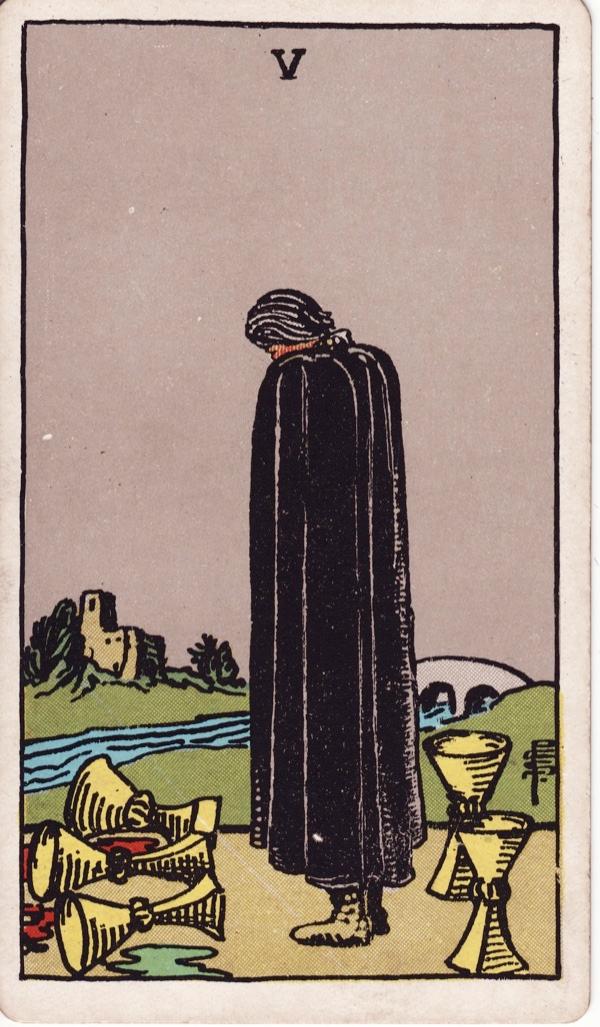
Five of Cups5 A reversed card is not a verdict
A reversed card is often read as “the opposite” or “everything is bad”. In classical practice it more often means delay, an inner process or an excess of the same energy. The upright Five of Cups is grief over what was spilled; reversed, it is grief that is letting go — you are already turning towards the two cups still standing. Look at the neighbours: next to the Ace of Cups, the reversed Five speaks of feeling returning; next to the Tower, of a loss not yet admitted. Ask yourself where this energy is blocked in you. And a spread full of reversals is a message in itself: the time has not come, or you are holding yourself back.
Discuss in a new topic - From the Arcanoir editors
Full → Reduced
- Full
- 11
- → 2
- Full
- 22
- → 4
- Full
- 33
- → 6
Numbers 11 and 22: reduce or not
In the Pythagorean tradition, 11, 22 and 33 are master numbers and are not reduced when the life path is calculated. When reading them, keep both values in mind: 11 and 2, 22 and 4. A master number is not a mark of being chosen but a higher voltage: 11 is sensitivity and intuition that need the practical, partnering skill of the two; 22 is the scale of a plan that holds only on the discipline of the four. If your life now is about everyday matters, lean on the reduced number; if it is about a big project or a calling, on the full one. A higher number is not a higher worth: every number has its own work.
Discuss in a new topic - From the Arcanoir editors
- Two-hour period
- 11:00 — 13:00 · Wu
- Meridian
- HT · Heart
- Open point
- HT8 · Shaofu
The open point: why it changes every two hours
Chinese chronopuncture divides the day into twelve two-hour periods, and in each energy peaks in one meridian: from 11 to 13 in the heart, from 17 to 19 in the kidneys. The open point is the one considered most receptive then; by the simplest rule (the na-zi method) it is the meridian’s own point — HT8 Shaofu in the Wu hour. In Su-Jok it is worked through correspondence points on the hand. This is not treatment or a substitute for a doctor, but a rhythm for your attention: in the heart hours, do not overload yourself with conversations and decisions; in the kidney hours, let your body rest. The dial on the home page shows the current point.
Discuss in a new topic - From the Arcanoir editors

The StarXVII Card of the day: a month of observation instead of predictions
The card of the day works best as a lens, not a forecast. In the morning, draw one card and write one line about what you expect from it. In the evening, add where you recognised it: in a conversation, a decision, a mood. After thirty days you will have not a pile of coincidences but a map of your own repetitions: which suits arrive in tense weeks, which arcana come before changes. In Arcanoir you draw it once a day and cannot redraw it — a second card “just in case” cheapens the first. The Star in the morning promises no lucky day; it asks what you hope for today and what you are doing about it.
Discuss in a new topic - From the Arcanoir editors
Why reread a spread a month later
Memory rewrites predictions: a month later it seems the cards “said it all” or “got nothing right”, though you no longer remember what actually came up. The journal keeps the original — the question word for word, the cards, the positions and the first reading. Reread it after thirty days and answer three questions: which position described what happened most precisely; what you did after the spread; what turned out to be not about the event but about you. This is how your own deck vocabulary forms: for one person the Eight of Wands is always about messages, for another it is about travel. Only you can see your journal notes in Arcanoir.
Discuss in a new topic- Day 0
question, cards, first reading
- Day 30
what matched and what you did
- Day 0